| “In the last 30 years we’ve really moved into exceptional territory,” Gavin Schmidt, director of Nasa’s Goddard Institute for Space Studies, said. “It’s unprecedented in 1,000 years. There’s no period that has the trend seen in the 20th century in terms of the inclination (of temperatures).” “Maintaining temperatures below the 1.5C guardrail requires significant and very rapid cuts in carbon dioxide emissions or co-ordinated geo-engineering. That is very unlikely. We are not even yet making emissions cuts commensurate with keeping warming below 2C.” |
| “It’s the long-term trend we have to worry about though and there’s no evidence it’s going away and lots of reasons to think it’s here to stay,” Schmidt said. “There’s no pause or hiatus in temperature increase. People who think this is over are viewing the world through rose-tinted spectacles. This is a chronic problem for society for the next 100 years.” Schmidt is the highest-profile scientist to effectively write-off the 1.5C target, which was adopted at December’s UN summit after heavy lobbying from island nations that risk being inundated by rising seas if temperatures exceed this level. Recent research found that just five more years of carbon dioxide emissions at current levels will virtually wipe out any chance of restraining temperatures to a 1.5C increase and avoid runaway climate change. |

Climate Change: How Skewed Are We... Really?
Tuesday, 30 August 2016
NASA Double Shot:Alaska’s Bubbling Lakes - Measuring Sea Ice at the Peak of Melt

Sunday, 28 August 2016
Carbfix Double Shot plus bonus made in Canada CCS Solution
| CarbFix is a collaborative research project between Reykjavik Energy, the University of Iceland, Columbia University and CNRS that aims at developing safe, simple and economical methods and technology for permanent CO2 mineral storage in basalts. The CarbFix team had demonstrated that over 95% of CO2 captured and injected at Hellisheidi geothermal Power Plant in Iceland was mineralized within two years. This contrasts the previous common view that mineralization in CCS projects takes hundreds to thousands of years. Industrial scale capture and injection have been ongoing at the power plant since 2012. |
| From the beginnings: Reykjavik Energy's Head of Innovation and Development discusses the CarbFix program, an international project to store carbon emissions in rock, and the role a major geothermal plant is playing in the effort. |
SaskPower Carbon Capture Test Facility (CCTF) Tour: a virtual tour of the recently opened Carbon Capture Test Facility (CCTF) at Shand Power Station in Estevan, SK. The CCTF was built to provide technology developers with an opportunity to test new and emerging carbon capture systems for controlling carbon emissions from coal-fired power plants.
|
Wednesday, 24 August 2016
Microsoft Research Double Shot on Climate Change
Microsoft Research collaborates with the world's foremost researchers in academia, industry and government to move research in new directions across nearly every field of computer science, engineering and general science.
| Networks in Climate Science The El Nino is a powerful but irregular climate cycle that has huge consequences for agriculture and perhaps global warming. Predicting its arrival more than 6 months ahead of time has been difficult. A recent paper by Ludescher et al caused a stir by using ideas from network theory to predict the start of an El Nino toward the end of 2014 with a 3-in-4 likelihood. We critically analyze their technique, related applications of network theory, and also attempts to use neural networks to help model the Earth's climate. John Baez is a professor of mathematics at U.C. Riverside. Until recently he worked on higher category theory and quantum gravity. His internet column 'This Week's Finds' dates back to to 1993 and is sometimes called the world's first blog. In 2010, concerned about climate change and the future of the planet, he switched to working on more practical topics and started the Azimuth Project, a collaboration to create a focal point for scientists and engineers interested in environmental issues. One part of this project is developing the mathematics of networks of all kinds: chemical reaction networks, belief networks, signal-flow diagrams, and so on. |
| David MacKay Dept of Engineering Uni of Cambridge Stuff machine learning, let’s talk about climate change David MacKay, born 22 April 1967, died 14 April 2016. We are saddened by the loss of Professor Sir David MacKay, Regius Professor of Engineering, who lost his battle against stomach cancer on Thursday 14th April 2016. He was 48 years old. |
Monday, 22 August 2016
ClimateTruth.org Double Shot Actually more to the point: Exxon double
| ClimateTruth.org is an online community of more than 170,000 people combatting the denial, distortion and disinformation that blocks bold action on climate change. Since 2012, we’ve been pushing public officials, institutions, and corporations to cut ties with the polluter front groups and other vested interests that spread disinformation and block action on climate change. |
| Exxon Knew Exxon Profits from disasters. Consider this: carcasses of more than 35,000 birds and 1,000 sea otters, which was considered to be a fraction of the animal death toll because carcasses typically sink to the seabed. It’s estimated 250,000 seabirds, 2,800 sea otters, 300 harbor seals, 250 bald eagles, up to 22 killer whales died along with billions of salmon and herring eggs. Exxon Valdez ring a bell? |
Inter-American Development Bank Double shot
| Inter-American Development Bank: supporting efforts by Latin America and the Caribbean countries to reduce poverty and inequality and improve the quality of life. We aim to bring about development in a sustainable, climate-friendly way. |
| Inter-American Development Bank: working to improve lives in Latin America and the Caribbean. Through financial and technical support for countries working to reduce poverty and inequality, we help improve health and education, and advance infrastructure. Our aim is to achieve development in a sustainable, climate-friendly way. With a history dating back to 1959, today we are the leading source of development financing for Latin America and the Caribbean. We provide loans, grants, and technical assistance; and we conduct extensive research. We maintain a strong commitment to achieving measurable results and the highest standards of increased integrity, transparency, and accountability. |
Thursday, 18 August 2016
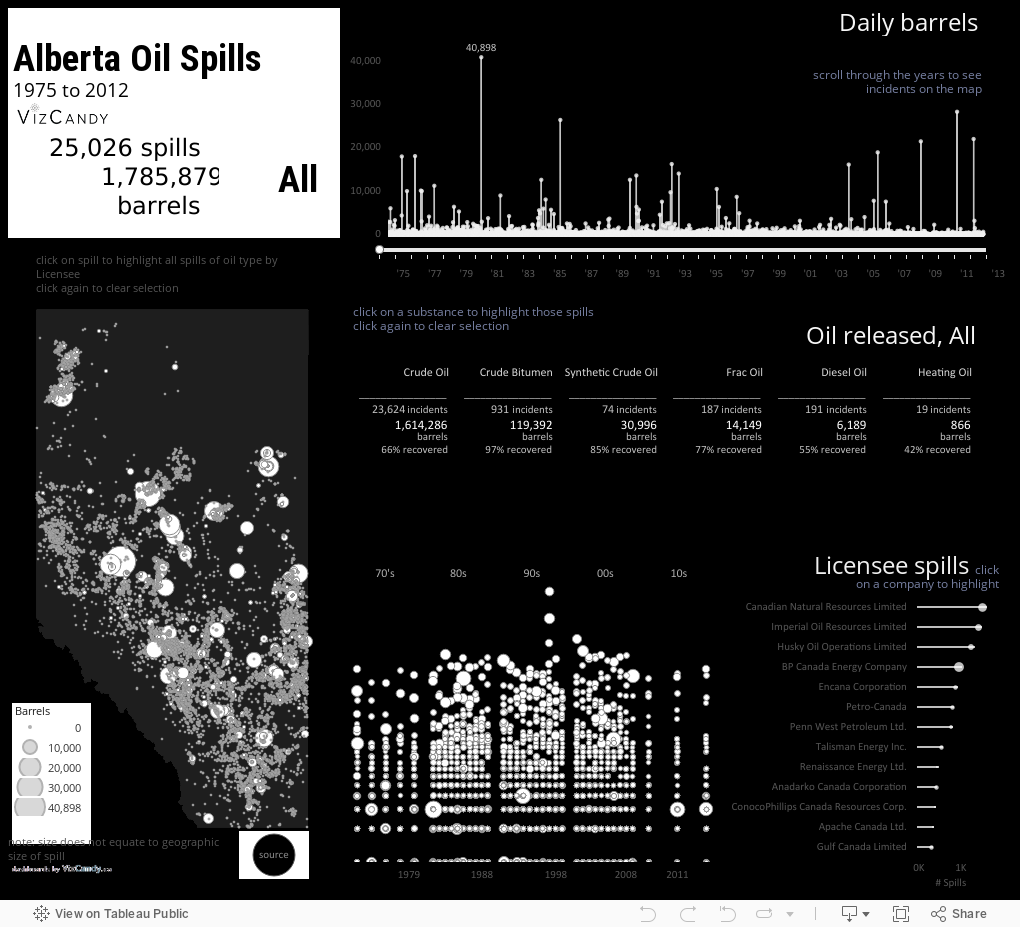
For the hardcore Graphanatic A Tableau Public Double Shot - Emissions / Oil Spills
 |
|---|
| What is Tableau Public? Tableau Public is a free service that lets anyone publish interactive data visualizations to the web. Visualizations that have been published to Tableau Public (“vizzes”) can be embeded into webpages and blogs, they can be shared via social media or email, and they can be made available for download to other users. Visualizations are created in the accompanying app Tableau Desktop Public Edition (or another Edition of Tableau Desktop) - no programming skills are required. Be sure to look at the gallery to see some of the visualizationspeople in the community have been creating. |
 |
Subscribe to:
Posts (Atom)